Level up your style with Kibbe Body Types

What Is the Kibbe System? A Fun, Honest Introduction to Your Unique Style Identity
If you’ve spent any time lurking on fashion forums, style blogs, or TikTok’s niche corners of personal styling, chances are you’ve come across the name Kibbe. If not, allow me—Mama Bloom—to give you a crash course in one of the most oddly liberating style systems out there.
First Things First: What Is Kibbe?
Is it kibble? (Nope, not dog food.) Is it some obscure medical terminology? (Also no.) The Kibbe System is actually a body typing method developed by American stylist David Kibbe in the 1980s. Unlike other style systems, this one isn’t about hiding your “flaws” or squeezing yourself into arbitrary categories based on body parts. Instead, it’s about celebrating your natural features and working with them, not against them.
It’s part science, part intuition.
A Little History
Remember the fruit-based body types from the early 2000s? Apple, pear, banana, hourglass? The Kibbe system is like that except it’s deeper, more detailed, and way more nuanced. It doesn’t just focus on measurements or silhouettes but considers your bone structure, facial features, body lines, and overall vibe.
And yes, while it does come with a quiz (because of course it does), it’s not about putting you in a box it’s about discovering your image ID and using that discovery as a catalyst for your personal growth and style.
Why Should You Care?
Honestly? Because the Kibbe system can be freeing. At its core, it’s about self-acceptance and creative expression. Instead of trying to “balance out” your hips or hide your broad shoulders, you learn how to dress in a way that makes your natural shape look harmonious and intentional. Kibbe aims to highlight our unique features using fashion and personal style.
For example:
- A curvier woman might be encouraged to wear soft, flowing fabrics that honor her shape. Not hide it.
- A tall, athletic person might be guided toward loose, voluminous styles that emphasize movement and elegance, rather than trying to shrink themselves with flat shoes and hunched posture.
Speaking personally, as a self-proclaimed Soft Natural, I’ve found so much peace and confidence in understanding my own lines and energy. I no longer wonder why that gorgeous body con dress looked amazing on the mannequin but looked uncomfortably tight and restrictive on me. Sometimes an item of clothing can be beautiful, well made and perfectly tailored but still not the right piece of clothing for my body type. And that's okay.
So What Is a Kibbe Type?
Great question. The Kibbe Image Identity System is based on the concept of yin and yang, or the balance between feminine (yin) and masculine (yang). This isn’t about gender it’s about shape, structure, and essence. Yin features are characterized by roundness, small hands and feet, large eyes and smaller stature. Yang features are angular or blunt bone structure, tall, muscular, narrow, and lean.
** Side Note
Many people find the masculine and feminine spectrum to be off putting, as they believe it implies one has a masculine appearance if they fall into a yang type. This is not the case. Yang types are far more common in models then yin. Think of the spectrum as referring to shape not gendered expectations of appearance. Yang is long, angular, and sharp, and yin is soft, rounded, and delicate.
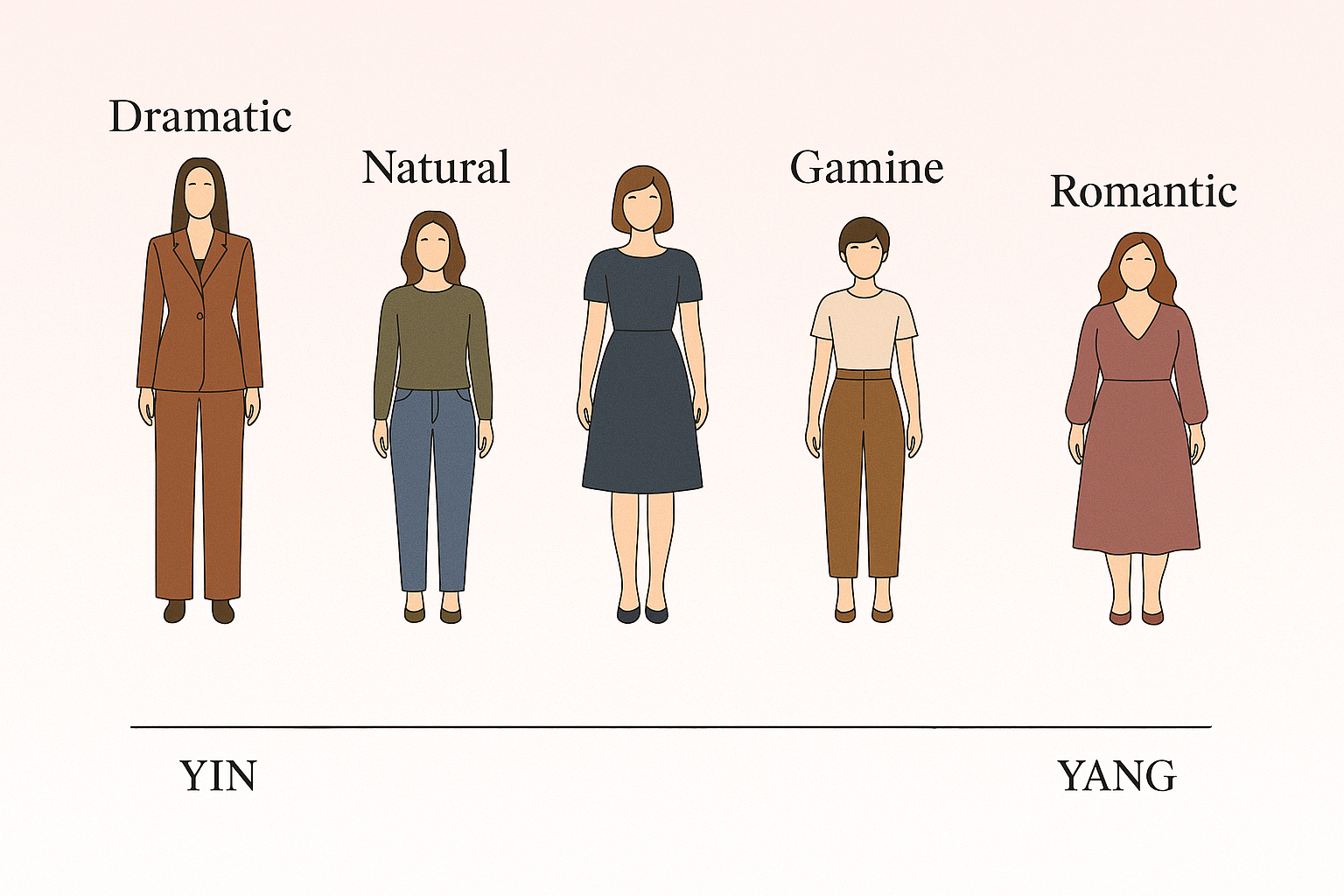
There are five main categories, each with a few subtypes, making up 13 body types in total:
- Dramatic – Angular, elongated, bold. Think striking lines and strong presence.
- Natural – Broad, blunt, athletic. Effortless and earthy.
- Classic – Symmetrical, balanced, elegant. Perfectly proportioned.
- Gamine – Compact, youthful, eclectic. A mix of yin and yang in a petite package.
- Romantic – Soft, curvy, feminine. Delicate, lush, and sensual.
Each type falls somewhere on the spectrum of yin to yang, with combinations and hybrids in between (e.g., Soft Natural, Flamboyant Gamine, Theatrical Romantic, etc.).
Here’s a quick breakdown of the two energies:
- Yin: Curves, softness, rounded lines, flowing fabrics, delicate details.
- Yang: Structure, sharpness, vertical lines, geometric cuts, crisp fabrics.
The Real Beauty of the Kibbe System
What makes Kibbe special is its holistic approach. It's not just about clothes it's about how your hair, makeup, accessories, and your essence. It helps you create a full, harmonious look that feels uniquely you.
And most importantly? Kibbe encourages you to stop fighting your body and start styling it in a way that feels good. Not “flattering” by someone else's standards.
Final Thoughts
Whether you use personal style to express your creativity, boost your confidence, or simply have fun, the Kibbe system offers a fresh and affirming way to look at your body and wardrobe. No more trying to shrink, elongate, hide, or distract. Just you, styled beautifully as you are.
So if you’ve ever stood in front of the mirror wondering why that one outfit doesn’t work for you maybe try something else that highlights your beautiful and unique features. When it comes personal growth our personal style plays a huge role in how we come across. I hope to make a few more posts on kibbe personal style, colour theory and more.
Now go forth, internet bestie. And style yourself like the harmonious, radiant work of art you are. Bloom with confidence.